 by
by 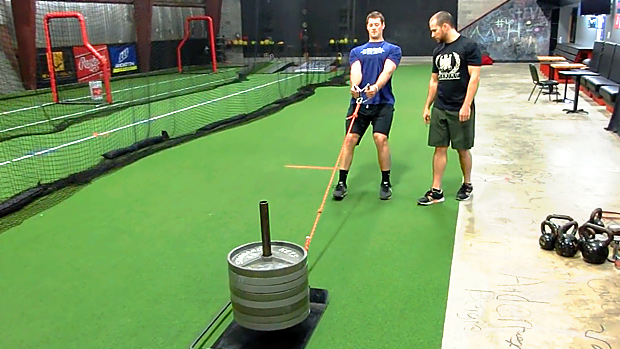
It’s quite clear that strength training (assuming the exercises are similar to the movement patterns to your sport) is helpful. Nathan Adrian claims to be able to do 4 reps of pull ups with an extra 60kg attached. Michael Phelps claims to be able to do 30 pull ups (which is even more impressive at his weight). However, the one problem with traditional strength training is that it involves both a concentric and eccentric portion, unlike most sports that only involves the concentric portion.
For a bodybuilder, eccentrics are amazing, as it increases muscle mass. However, for most sports, our goal in the weight room is not to add muscle mass, but to maximize our strength-to-weight ratio. If we can gain the strength(improve CNS efficiency) via the concentric and minimize the mass gain from the eccentrics perhaps this would be ideal.
Another benefit of concentric only training is improved recovery time and less soreness. As great as strength training can be, it should be supplemental and we don’t want it to affect their main training. COT would allow the athlete to train their sport more often and at a more optimal and less fatigued state. This may also be why Olympic lifters (whose movements are generally more concentric only) are known to train with much higher frequency than most powerlifters.
What Do The Studies Say?
- West et al concluded that a reverse sled pull training session (a concentric-only exercise) may provide an effective training stimulus whilst causing minimal stress to recovery mechanisms. Athletes in the study performed 5 sets of 2 x 20m sled pulls with a sled loaded with 75% of their body mass. The session induced significant elevations in testosterone, cortisol and lactate, indicative of a strong metabolic and hormonal stimulus. Despite creating this stimulus the training session did not induce significant muscle damage (determined creatine kinase levels) and only acutely impaired neuromuscular function. Specifically, jump performance was reduced at 1 hour post-session but was recovered at 3 hours post-session. ‘Traditional’ resistance training sessions may be expected to impair neuromuscular function for around 2 days.
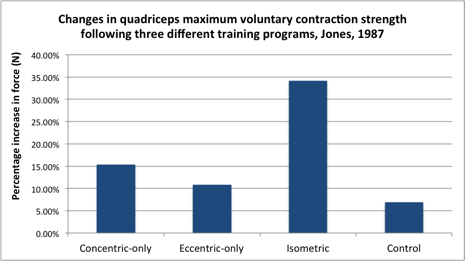
- Here is another promising study that shows that concentric training is not only enough to gain strength gains, but it even better than eccentrics. Looking at the chart below, perhaps including isometrics to the concentrics could be beneficial.
Exercises:
Here are several examples of COT exercises. Let me know if you find more!
Tire Flipping
Sled pulls
Sled pushes
Slides
Lunges (up stairs)
Movement training (watch Ido portal)
Pull ups/Dips where you let go at top. (pull-ups shown below)
If you are someone who has slower recovery I would definitely recommend playing around with this idea!