Concentric Only Training for Athletes

Read More

It’s quite clear that strength training (assuming the exercises are similar to the movement patterns to your sport) is helpful. Nathan Adrian claims to be able to do 4 reps of pull ups with an extra 60kg attached. Michael Phelps claims to be able to do 30 pull ups (which is even more impressive at his weight). However, the one problem with traditional strength training is that it involves both a concentric and eccentric portion, unlike most sports that only involves the concentric portion.

For a bodybuilder, eccentrics are amazing, as it increases muscle mass. However, for most sports, our goal in the weight room is not to add muscle mass, but to maximize our strength-to-weight ratio. If we can gain the strength(improve CNS efficiency) via the concentric and minimize the mass gain from the eccentrics perhaps this would be ideal.

Another benefit of concentric only training is improved recovery time and less soreness. As great as strength training can be, it should be supplemental and we don’t want it to affect their main training. COT would allow the athlete to train their sport more often and at a more optimal and less fatigued state. This may also be why Olympic lifters (whose movements are generally more concentric only) are known to train with much higher frequency than most powerlifters.


What Do The Studies Say?

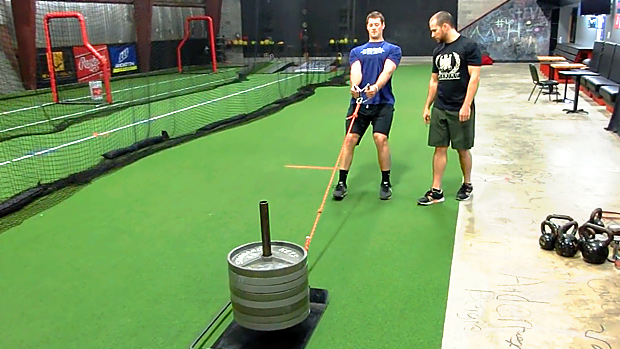
  1. West et al concluded that a reverse sled pull training session (a concentric-only exercise) may provide an effective training stimulus whilst causing minimal stress to recovery mechanisms. Athletes in the study performed 5 sets of 2 x 20m sled pulls with a sled loaded with 75% of their body mass. The session induced significant elevations in testosterone, cortisol and lactate, indicative of a strong metabolic and hormonal stimulus.  Despite creating this stimulus the training session did not induce significant muscle damage (determined creatine kinase levels) and only acutely impaired neuromuscular function. Specifically, jump performance was reduced at 1 hour post-session but was recovered at 3 hours post-session. ‘Traditional’ resistance training sessions may be expected to impair neuromuscular function for around 2 days.
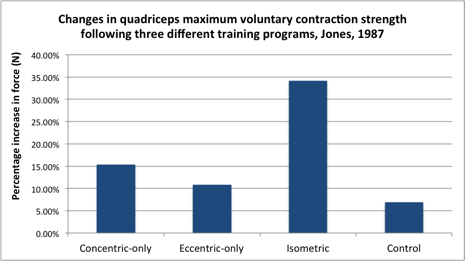
  2. Here is another promising study that shows that concentric training is not only enough to gain strength gains, but it even better than eccentrics. Looking at the chart below, perhaps including isometrics to the concentrics could be beneficial.
 

Exercises:

Here are several examples of COT exercises. Let me know if you find more!

Tire Flipping

Sled pulls

Sled pushes

Slides

Lunges (up stairs)

Movement training (watch Ido portal)

Pull ups/Dips where you let go at top. (pull-ups shown below)

If you are someone who has slower recovery I would definitely recommend playing around with this idea!

A video of Butterfly-related Exercises

Here is a video of a few of the many exercises I perform out of the pool, that I believe can help improve your speed power and mobility in the butterfly.


The exercises I have performed are as follows:

0:03 – shoulder dislocates

0:06 – hanging swings

0:14 – Weighted muscle ups

0:20 – Front lever pull overs

0:28 – Weighted pull ups

0:40 – stranding ab roll-outs

0:49 – pull overs

0:54 – knee jumps

1:01 – bridge push ups


Want to learn how to maintain strength, endurance mobility and prevent weight gain during a vacation? Grab a free e-book  where I offer the short bodyweight workouts and nutrition plan that I use that still allows do this without sacrificing your relaxing vacation.

What Swimmers can learn from French Rock Climbers

Back in the 1990’s, the French were outperforming everyone in rockclimbing. Their secret? The french were training their pulling strength with isometric contractions. An exercise now called the “Frenchie”.

A frenchie is a series of pull-ups which incorporates isometric lock offs in the range of motion.

One repetition of a frenchie is shown below.

  1. Start Hanging
  2. Pull Up fully to the highest position and lock off at the full lock position
  3. Lower down to  a dead hang
  4. Pull Up and lower down to lock off at a 90 degree arm position
  5. Lower down to a dead hang
  6. Pull Up and lower down to lock off at a 120 degree arm position
  7. Lower down to dead hang
  8. Repeat


This is the standard frenchie, however there are many variations of incorporating isometric contractions into your training. The video below shows incredibly strong calisthenics athletes incorporating isometrics in a different way.


Isometric contractions are great because they offer higher muscle fiber recruitment. A recent study comparing the level of muscle activation during isometric, concentric, and eccentric muscle actions found that a person can recruit over 5% more motor-units/muscle fibers during a maximal isometric muscle action than during either a maximal eccentric (lowering) or maximal concentric (lifting) action; that’s 95.2% for isometric compared to 88.3% for the eccentric and 89.7% for the concentric. [Babault et al. 2001.]


Nathan Adrian is know to be able to perform 4-5 reps of pull-ups with an additional 132 lbs on him. Michael Phelps can do 30 consecutive bodyweight pull-ups (which is quite incredible given his height and weight).  It is quite evident that pull-ups translate well to swimming.


force velocity curve showing force for concentric isometric and eccentric movements


Isometrics are a great way to break plateaus. As evident in the force-velocity curve below when you perform an isometric exercise you will be able to pull or push more weight than during a dynamic exercise.

Personally when I was stuck at a 1RM (one rep max) of 125lbs for pull-ups, I incorporated this trick into my training regiment by performing isometrics with 125-140lbs. When doing weight over my 1RM (supra maximal training), I would use a box to to get my chin over the bar and just work the isometric and eccentric portion. I was able to break 140lbs in a matter of weeks.

Although dynamic training should always be the bread and butter of your strength training program, the isometrics are a great supplement!

Order Matters!!

On most swim teams it is quite common to go hit the weights as a team. Unfortunately this is one of the worst things that can be done. Since the whole team usually has the same lift plan (ie. does the same exercise) swimmers try to rotate through the lifting plan. For simplicity lets assume there are 9 swimmers and 3 exercises for the workout: Dips, lateral raises(LR) and tricep extension(TE). So three people would start on dips , three would start on LR and three would start on TE. This is a big mistake. In this scenario, dips should always be performed first. It doesn’t matter to me if you eat dessert before dinner, but do not do accessory exercises before the big compound ones! Big compound exercises such as dips, chin-ups, standing press, and squats are the most important exercises for getting stronger. In terms of the Pareto Principle, these are the 20% that give 80% of the results! I honestly want to say they are going to give you 90% of the results. It is important to start your workouts with these so you can hit some big numbers and ideally hit a PR.

So here are two options:

-lift at different times

-be patient and wait your turn to do the compound exercise first.

Furthermore I think it is important to keep the same order in your workouts so you can track your progress better. Even with the secondary (such as rows) and accessory exercises try to keep them the same order if possible.

Should swimmers do Reverse Pyramid Training

Back in college, the weightlifting program incorporated rep schemes such 10,8,6 or 12,10,8.  Also known as the strandard pyramid scheme. The goal is to increase the weight on each set whilst decreasing the the repetitions. Such as the example below.

Incline Dumbell press:

Set 1: 10 reps – 65 lbs

Set 2: 8 reps – 70 lbs

Set 3: 6 reps –  75lbs.

However I was rarely able to do this, instead this is what I usually got.

Set 1: 10 reps – 65 lbs

Set 2: 6 reps – 70lbs

Set 3: 2 reps 75lbs  or 5 reps 70lbs.

Due to fatigue I usually cannot complete the second set. After failing the second set, I either attempt to stick to the weight scheme on the third set and fail miserably or I try to stick to the rep scheme as close as possible by not increasing the weight. I believe that unless you are a total beginner with no muscle mass to feel the fatigue or you are just not working at a high intensity on the previous sets it is almost impossible to complete this.

After a while of be unable to perform the rep-weight scheme of the standard pyramid scheme, I started to train the way I thought was natural, which was the heaviest weight first. 

After college, I learned that it’s actually called reverse pyramid training (ie. RPT). The example is below

Set 1: 6 reps – 75 lbs

Set 2:  8 reps – 70 lbs

Set 3: 10  reps –  65 lbs.

This also makes the lifting a lot more fun. Just like racing on taper is awesome, being able to hit the biggest weight fresh is fun since you can perform much better. I’m always excited to hit the gym and see if I can hit PRs.

Reverse-Pyramid-Training

A swimmer’s main goal in the gym in-season should not be to gain muscle mass but gain strength. I think RPT is great for this since you will be lifting heavier weights. YOU WILL BE SURPRISED HOW MUCH HEAVIER YOU CAN LIFT on your max set when you hit them first. Since you will be lifting much more weight it is going to train your central nervous system much more. Improved CNS is the key to getting stronger without adding size. RPT is also better for a low volume weightlifting routine which is what I recommend in-season.


Chalk


I’ll keep this post short because there isn’t much to be said. Powerlifters, gymnists, rockclimbers all use chalk. It is clearly effective.

The goal of lifting is not to work your grip strength, grip strength is useless in swimming. Missing a rep on pullups because of lost grip is only going to hurt you, and all the energy wasted on grip can be used better somewhere else.

Go to amazon, and buy yourself a bag of chalk. They cost 5-10$.

chalk

P.S. if you’re stingy like me, and think you can save money by using classroom chalk, don’t waste your time. I’ve already tried it, and it doesn’t work :p

Tracking you lifts

Many fitness trainers say the one golden rule to success in the weight room is to track your lifts.

It is quite obvious that it is important to track your progress in the weight-room if you are trying to progress.

Here are three reasons why:

  • 1) By tracking your progress, you are more likely to be consistent.

If you track your lifts, you are more likely to stick to a plan.

  • 2) You are more likely going to try harder

If you’re about to hit a set of dips and you see in your log that last week you did 7 reps on that particular weight, you are going to try extra hard to make sure you get in 8 this time.

  • 3) More data is always better!

You will learn what works best for you. Furthermore, if you plateau in an exercise it will be evident in the tracking log since you can look at the progress (or lack of progress) in the log. When you plateau you know it is probably time to try something new.

Conclusion: I recommend buying a little notebook and writing down all your workouts.

traklifts

Why I study powerlifters

Person A weighs 150lbs and can bench 275lbs. Person B weighs 200lbs and can bench 300lbs.

As a swimmer which person would you rather be?

Clearly person A as he is lifting 1.83 times his bodyweight compared to the 1.5 of person B.

Person A has a higher relative strength than person B.

An important component of swimming is relative strength.  Ideally you want to maximize propulsion by increasing strength whilst minimizing your drag. Although drag is proportional to surface area and not weight, weight is correlated to drag and is much easier to measure. For this reason, relative strength is a very important component of swimming.

I study powerlifters because they have an extremely high relative strength. Why? Because it is their sole purpose. While a swimmer’s performance is measured by how long it takes them to complete x many laps, a powerlifter’s performance is based on how much they can lift compared to other competitors in their weight class.

The world record for bench in the 150lb class is 498lbs! That’s over three times his bodyweight!

You will see in further posts that a lot of my inspiration comes from powerlifting.