Here is a video of a few of the many exercises I perform out of the pool, that I believe can help improve your speed power and mobility in the butterfly.
The exercises I have performed are as follows:
0:03 – shoulder dislocates
0:06 – hanging swings
0:14 – Weighted muscle ups
0:20 – Front lever pull overs
0:28 – Weighted pull ups
0:40 – stranding ab roll-outs
0:49 – pull overs
0:54 – knee jumps
1:01 – bridge push ups
Want to learn how to maintain strength, endurance mobility and prevent weight gain during a vacation? Grab a free e-book where I offer the short bodyweight workouts and nutrition plan that I use that still allows do this without sacrificing your relaxing vacation.
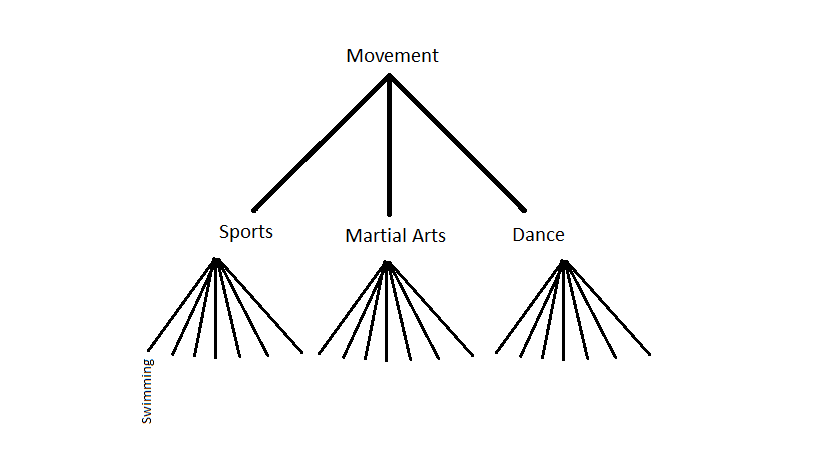
Recently, I’ve come across Ido Portal, a visionary from Israel. Ido started off with Afro-Brazilian Capoeira, but eventually started practicing “Movement” and is now the pioneer of the “Movement” culture.
What is “Movement”?
“Movement is big. Bigger than any specific movement discipline and it contains within it HUGE ‘worlds’ like the world of fitness, dance, martial arts, strength, flexibility, circus and more. Specializing is great – but beyond our specialties – we are all HUMAN first, MOVERS second and only then SPECIALISTS.” – Ido Portal
A movement pattern involves combinations of concentric, eccentric, and isometric contractions in some range of motion. We are all movers. Whether it be Rowing, Running, Basketball, Swimming, Hip-hop, or Brazilian Jiu Jitsu, we are all practicing on becoming the best ( whether that be the most powerful , the most efficient, the most controlled , the most graceful) at a specific movement pattern. Ido believes that it is important to get your head out of the gutter and to look around because there is so much you can learn about your discipline from studying others movers.
At first glance of this video you may find his practices to be strange but this man is a genius! You will also be surprised how hard some of these movements are. The movement he performs at 0:35 is called the lizard crawl. Try it for yourself.
I have a lot of respect for this individual and have been incorporating many of his practices in my training regiment. Be sure to watch his videos on Youtube since he provides a lot of good ideas.
Ankle flexibility and strength is an important part of swimming, yet it is often over-looked. I rarely see swimmers stretching their ankles. Increased ankle flexibility and strength will do wonder to your kicking propulsion and do ten times more good to your kick than improving your squat.
Out of all the disciplines out there, Ballet dancers are at the top of the game when it comes to ankle flexibility and strength. Pictures speak a 1000 words, so below is a picture in which a ballet dancer supports the whole body on the tip of a fully extended foot. This technique is called the “Pointe”. It is usually done with “pointe shoes” and requires tremendous ankle strength and flexibility.
.
Although its not necessary for swimmers to be able to do the pointe, there are many aspects of the pointe and training done to achieve the pointe that can be beneficial for swimmers. I found two instructional videos on Youtube to be informative. The first one focuses more on the ankles, and it was interesting to hear that Ballerinas utilize a form of PNF stretching as well. At the 1:30 mark she calls it “resistance stretching” but it is essentially the same.
The second video focuses more on toe flexibility, which I have never seen anyone in the swimming world talk about. However I think it can also be very advantageous to have flexible toes. Furthermore, there is no easier way to separate yourself from the crowd than by focusing on something no one else is!
When practicing for the one arm chin-up (OAC) , I purchased a pair of gymnastic rings to prevent elbow strain from practicing on the bar. However, I tried various other exercises on the rings such as the dip. Although I can do dips on the bar with 120lbs attached to me, on the rings I was barely able to do them with just my bodyweight. Furthermore, I was shaking immensely when doing them, meaning that a lot of my energy was going into stabilization. This was a humbling experience but also a very important one. It taught me that my stabilizers were weak since I was only practicing dips on the bars. Since swimming is done in an unstable environment (unlike land sports where the athlete is grounded), I believe stabilization work is vital. It is important to practice many exercises such as the rows, front-lever pull downs and dips on the rings.
“Everything new is a well-forgotten old” – Russian proverb
Although the TRX is good and is used by many swimming programs to work the stabilizers I believe the TRX is just a big marketing scam. It is just a copy of the original gymnastic rings. Furthermore, the TRX costs over $200 compared to the rings that cost less then $20 (because people are silly enough to pay $200 for nylon straps). Lastly, the TRX doesn’t allow for movements such as muscle-ups, dips and rows. You can do pretty much all the TRX exercises using the rings, but you can’t do all the rings exercises on the TRX.
Conclusion: Invest $20 on a pair of gymnastic rings to work on your reactive stability.
 by
by