The Art of Swimming

Being both a dancer and swimmer for many years, I can say there is a great similarity between the two.

I practice a funk style dance called locking. Although there are many variations, there are only about 10-15 moves in the dance. Even though I have been practicing for over ten years, I have not achieved mastery in the dance.

You may think I’m a slow learner, but ask yourself this.

Swimming has five moves. Freestyle, backstroke, butterfly, breaststroke and the dolphin kick. How long have you been swimming and have you mastered all five yet?

I surely have not.

art of swimming

Order Matters!!

On most swim teams it is quite common to go hit the weights as a team. Unfortunately this is one of the worst things that can be done. Since the whole team usually has the same lift plan (ie. does the same exercise) swimmers try to rotate through the lifting plan. For simplicity lets assume there are 9 swimmers and 3 exercises for the workout: Dips, lateral raises(LR) and tricep extension(TE). So three people would start on dips , three would start on LR and three would start on TE. This is a big mistake. In this scenario, dips should always be performed first. It doesn’t matter to me if you eat dessert before dinner, but do not do accessory exercises before the big compound ones! Big compound exercises such as dips, chin-ups, standing press, and squats are the most important exercises for getting stronger. In terms of the Pareto Principle, these are the 20% that give 80% of the results! I honestly want to say they are going to give you 90% of the results. It is important to start your workouts with these so you can hit some big numbers and ideally hit a PR.

So here are two options:

-lift at different times

-be patient and wait your turn to do the compound exercise first.

Furthermore I think it is important to keep the same order in your workouts so you can track your progress better. Even with the secondary (such as rows) and accessory exercises try to keep them the same order if possible.

Should I breathe pure oxygen before a race?

Watching David Blaine’s TED talk “How I Held my Breath for 17 minutes”, I was inspired to look into this. David Blaine got the world record in the static apnea with supplemental pure oxygen. He was the allowed to pre-breathe 100% oxygen (as opposed to regular air that is 21% oxygen) for up to 30 minutes prior to breathe-holding. He no longer has the record but for the sake of this post here are the current static apnea records for both with and without pure oxygen supplementation.

With pure oxygen

23:01 Goran Čolak 20 June 2014 VirCroatia Guinness

Without pure oxygen

11:54 [2] Branko Petrović 7 October 2014 DubaiUAE

Humans can hold their breath almost twice as long with pure oxygen! So I did my research…and here’s what I found.

Q1: Do other sports use pure oxygen?

A1: Yes, if you watch NFL you will see football players breathing pure oxygen on the sidelines between plays.

Q2: Is it easy to obtain pure oxygen?

You can obtain canisters on amazon that are 95% oxygen for about 10$.

Q3: Is it effective?

After going through a few papers it seems they all agree that there is no benefit in breathing pure oxygen.

Q4: Why do they do it?

Not entirely sure. Possibly a placebo effect.


david blaine breaks the world record holding his breathe using pure oxygen

It seems that for athletic performance, ridding the body of CO2 is more important than increasing the body with O2. Furthermore the hemoglobin in your body can only hold so much oxygen at a time. The only possible scenario where pure oxygen may help, is if you have a swim meet in high altitude, but I don’t think most people need to worry about this.


Should swimmers do Reverse Pyramid Training

Back in college, the weightlifting program incorporated rep schemes such 10,8,6 or 12,10,8.  Also known as the strandard pyramid scheme. The goal is to increase the weight on each set whilst decreasing the the repetitions. Such as the example below.

Incline Dumbell press:

Set 1: 10 reps – 65 lbs

Set 2: 8 reps – 70 lbs

Set 3: 6 reps –  75lbs.

However I was rarely able to do this, instead this is what I usually got.

Set 1: 10 reps – 65 lbs

Set 2: 6 reps – 70lbs

Set 3: 2 reps 75lbs  or 5 reps 70lbs.

Due to fatigue I usually cannot complete the second set. After failing the second set, I either attempt to stick to the weight scheme on the third set and fail miserably or I try to stick to the rep scheme as close as possible by not increasing the weight. I believe that unless you are a total beginner with no muscle mass to feel the fatigue or you are just not working at a high intensity on the previous sets it is almost impossible to complete this.

After a while of be unable to perform the rep-weight scheme of the standard pyramid scheme, I started to train the way I thought was natural, which was the heaviest weight first. 

After college, I learned that it’s actually called reverse pyramid training (ie. RPT). The example is below

Set 1: 6 reps – 75 lbs

Set 2:  8 reps – 70 lbs

Set 3: 10  reps –  65 lbs.

This also makes the lifting a lot more fun. Just like racing on taper is awesome, being able to hit the biggest weight fresh is fun since you can perform much better. I’m always excited to hit the gym and see if I can hit PRs.

Reverse-Pyramid-Training

A swimmer’s main goal in the gym in-season should not be to gain muscle mass but gain strength. I think RPT is great for this since you will be lifting heavier weights. YOU WILL BE SURPRISED HOW MUCH HEAVIER YOU CAN LIFT on your max set when you hit them first. Since you will be lifting much more weight it is going to train your central nervous system much more. Improved CNS is the key to getting stronger without adding size. RPT is also better for a low volume weightlifting routine which is what I recommend in-season.


Optimal Body Fat for swimmers

On average swimmers tend to have a higher body fat percentage than land athletes. Swimming is an extremely forgiving sport when it comes to body fat. However between having the 3% body fat that is necessary for organ function and being 500lbs, there must be an optimal amount.


Study:

In a study done by the University of Miami, researchers artificially increased the bodyfat of 10 male and female swimmers by 2% or approximately 3.5 pounds. Fat was added by adding latex pads under a spandex triathlon suit in the swimmers’ abdominal, hip, thigh, chest, back, and buttock areas. The artificial fat was adjusted to ensure that it would have the same density as actual body fat. Each athlete swam a 50-yard freestyle race as fast as possible, with and without the pads.

Results:

“While the latex pads did improve flotation, they also slowed the swimmers down considerably. The athletes could rip through their 50-yard sprints in about 26.6 seconds without the added ‘fat’ but required around 27.4 seconds with the additional fat on board. Thus, each additional pound of fat slowed 50-yard swim times by approximately .2 seconds.”

My thoughts:

Now we should take this study with a grain of salt. Clearly it is far from perfect. It would be a lot more believable if the athletes actually gained 3.5 lbs of real fat for this experiment… Furthermore they only compared the performance in a 50 freestyle.. This is what I want to focus on..


One of the possible advantages of body fat is buoyancy since fat is less dense than lean body mass and the water. This can be very helpful in longer distances where the swimmers conserves energy by kicking less intensely (such as in a two beat kick). However in a shorter race buoyancy the swimmer is kicking much harder and buoyancy from fat is not going to be as necessary to keep the body parallel to the surface.


Secondly I believe that the main disadvantage of body fat in addition to the increased drag (via surface area) is from the energy dissipation due to vibrations. For those readers who haven’t come upon this concept before , this is the reason why competition suits are meant to be tight. Ian Thorpe used to have to cut his swim suits off with scissors. In shorter races where you are kicking very hard there will be a lot more energy dissipation if you have a high body fat percentage.

Furthermore this could be why the people who improved the most with the tech-suits back in ’08-’09 were the larger athletes.


Conclusion: I believe that its impossible to say there is an optimal amount that is general to every swimmer. Since everyone swims differently, has different limb proportions and adds fat differently to their body the number will change on an individual basis. I do believe however that being lean is more important for sprinters than distance swimmers. I conclude with a picture of former 1500m World record holder Grant Hackett who is currently doing a great job at making a comeback for the upcoming Olympics.
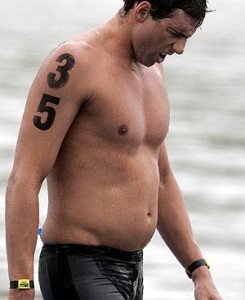
 

 hackett

Finger nails

Three weeks out of a taper meet, I usually stop cutting my nails. Although, I get made fun of for having long nails as a guy, it’s a small price to pay if it will even make me 1/100 of a second faster.

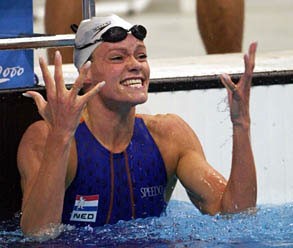
The idea is with longer nails, it increases the surface area of your hands and will aid in pulling more water. Clearly I am not the only one who has thought of this. When I googled it, I learned that Inge de Brujin is known for putting on fake nails before big competitions.

If you don’t know who she is, she is a four-time Olympic champion and a former world record-holder.

ingenails

Clearly she believes it helps. If you think it may help you as well try it out for yourself!

Hawthorne Effect

Each December, my old club would host a big taper meet. When I was 15, I remember a teammate of mine created a facebook even inviting all his non-swimmer friends to come to watch him break the 100 freestyle record.

The balls of this guy…..


In addition to his massive nuts he was also a popular guy so about twenty people came out to the meet.


JUST TO WATCH HIM SWIM THIS ONE EVENT.

Talk about pressure…

Anyways he went a best time by about half a second and broke the record.

The reason I tell this epic story is because I believe there is much to be gained from it.

Hawthorne Effect

The Hawthorne effect (also referred to as the observer effect) is a type of reactivity in which individuals modify or improve an aspect of their behavior in response to their awareness of being observed.


It was first discovered when Hawthorne Works Electric Company in Cicero Illinois ran an experiment to test whether lighting changes in the workplace would improve productivity. The result was that increasing the lighting improves the workplace productivity. However decreasing the lighting also increased productivity.  Later it was found that the improvements in productivity were independent of the lighting and were caused because the workers were being observed.


Lansdberger defined the Hawthorne effect as a short-term improvement in performance caused by observing workers.


I believe my teammate was able to utilize the Hawthorne effect to his advantage. Who knows.. maybe without the Facebook event he wouldn’t have broken the record..

How can swimmers benefit from this?

Theoretically, you could do the same thing and create a Facebook event for your next taper meet. However that seems a little excessive and the extra pressure might not be effective for everyone. I do think it could be useful in the weight room. Have team-mates watch you lift, maybe even bet money or dinner (if it’s legal) that you can complete the reps. If you can’t find anyone I find that even a camera is helpful. I record my lifts. It also has the benefit that you can watch the clip and check your form.

Asking coach for a harder practice

If you look online most weightlifting programs have a deload week every 4-8 weeks to allow the body to recuperate. However most elite-levels lifters who know their bodies much better, don’t take deload weeks in a strict schedule but instead listen to their bodies and take them when they feel it is necessary.

Let’s see how this idea can be transferred over to swimming.

To avoid overtraining, every coach will usually have 1-2 easier workouts a week to let the swimmers recover. However the coach can’t read your mind.

Imagine a day, where you for some unknown reason, feel terrific. You just woke up on the right-side of the bed and you feel like crushing it at practice today. However you show up on deck and you see that today’s practice that the coach wrote up is an easy recovery practice. What should you do??

I recommend talking to your coach and ask if he/she can write you a harder practice. Maybe you can find a few of your teammates who are motivated and also feel great to join your lane.

There are two benefits from doing this

-instead of wasting a great day, you murder a hard workout

-since you voluntarily did a hard workout, if there is a day in the future where you feel really under the weather for some reason, your coach might be more willing to give you an easier workout.

Conclusion: The next time there’s a recovery workout on a day you don’t feel you need it, SPEAK UP!

Chalk


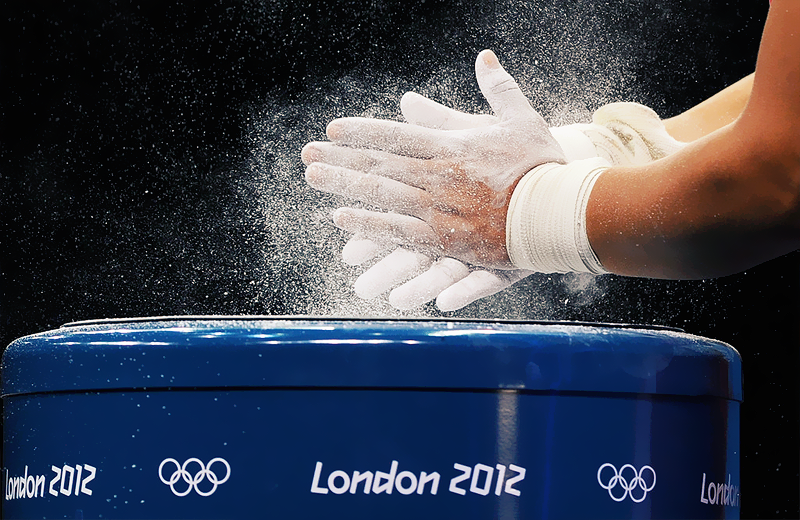
I’ll keep this post short because there isn’t much to be said. Powerlifters, gymnists, rockclimbers all use chalk. It is clearly effective.

The goal of lifting is not to work your grip strength, grip strength is useless in swimming. Missing a rep on pullups because of lost grip is only going to hurt you, and all the energy wasted on grip can be used better somewhere else.

Go to amazon, and buy yourself a bag of chalk. They cost 5-10$.

chalk

P.S. if you’re stingy like me, and think you can save money by using classroom chalk, don’t waste your time. I’ve already tried it, and it doesn’t work :p

Tracking you lifts

Many fitness trainers say the one golden rule to success in the weight room is to track your lifts.

It is quite obvious that it is important to track your progress in the weight-room if you are trying to progress.

Here are three reasons why:

  • 1) By tracking your progress, you are more likely to be consistent.

If you track your lifts, you are more likely to stick to a plan.

  • 2) You are more likely going to try harder

If you’re about to hit a set of dips and you see in your log that last week you did 7 reps on that particular weight, you are going to try extra hard to make sure you get in 8 this time.

  • 3) More data is always better!

You will learn what works best for you. Furthermore, if you plateau in an exercise it will be evident in the tracking log since you can look at the progress (or lack of progress) in the log. When you plateau you know it is probably time to try something new.

Conclusion: I recommend buying a little notebook and writing down all your workouts.

traklifts