Optimal Body Fat for swimmers

On average swimmers tend to have a higher body fat percentage than land athletes. Swimming is an extremely forgiving sport when it comes to body fat. However between having the 3% body fat that is necessary for organ function and being 500lbs, there must be an optimal amount.


Study:

In a study done by the University of Miami, researchers artificially increased the bodyfat of 10 male and female swimmers by 2% or approximately 3.5 pounds. Fat was added by adding latex pads under a spandex triathlon suit in the swimmers’ abdominal, hip, thigh, chest, back, and buttock areas. The artificial fat was adjusted to ensure that it would have the same density as actual body fat. Each athlete swam a 50-yard freestyle race as fast as possible, with and without the pads.

Results:

“While the latex pads did improve flotation, they also slowed the swimmers down considerably. The athletes could rip through their 50-yard sprints in about 26.6 seconds without the added ‘fat’ but required around 27.4 seconds with the additional fat on board. Thus, each additional pound of fat slowed 50-yard swim times by approximately .2 seconds.”

My thoughts:

Now we should take this study with a grain of salt. Clearly it is far from perfect. It would be a lot more believable if the athletes actually gained 3.5 lbs of real fat for this experiment… Furthermore they only compared the performance in a 50 freestyle.. This is what I want to focus on..


One of the possible advantages of body fat is buoyancy since fat is less dense than lean body mass and the water. This can be very helpful in longer distances where the swimmers conserves energy by kicking less intensely (such as in a two beat kick). However in a shorter race buoyancy the swimmer is kicking much harder and buoyancy from fat is not going to be as necessary to keep the body parallel to the surface.


Secondly I believe that the main disadvantage of body fat in addition to the increased drag (via surface area) is from the energy dissipation due to vibrations. For those readers who haven’t come upon this concept before , this is the reason why competition suits are meant to be tight. Ian Thorpe used to have to cut his swim suits off with scissors. In shorter races where you are kicking very hard there will be a lot more energy dissipation if you have a high body fat percentage.

Furthermore this could be why the people who improved the most with the tech-suits back in ’08-’09 were the larger athletes.


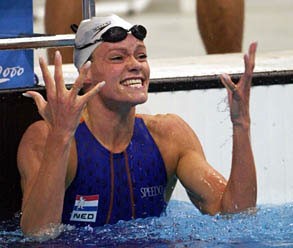
Conclusion: I believe that its impossible to say there is an optimal amount that is general to every swimmer. Since everyone swims differently, has different limb proportions and adds fat differently to their body the number will change on an individual basis. I do believe however that being lean is more important for sprinters than distance swimmers. I conclude with a picture of former 1500m World record holder Grant Hackett who is currently doing a great job at making a comeback for the upcoming Olympics.

 

 hackett

Finger nails

Three weeks out of a taper meet, I usually stop cutting my nails. Although, I get made fun of for having long nails as a guy, it’s a small price to pay if it will even make me 1/100 of a second faster.

The idea is with longer nails, it increases the surface area of your hands and will aid in pulling more water. Clearly I am not the only one who has thought of this. When I googled it, I learned that Inge de Brujin is known for putting on fake nails before big competitions.

If you don’t know who she is, she is a four-time Olympic champion and a former world record-holder.

ingenails

Clearly she believes it helps. If you think it may help you as well try it out for yourself!

Hawthorne Effect

Each December, my old club would host a big taper meet. When I was 15, I remember a teammate of mine created a facebook even inviting all his non-swimmer friends to come to watch him break the 100 freestyle record.

The balls of this guy…..


In addition to his massive nuts he was also a popular guy so about twenty people came out to the meet.


JUST TO WATCH HIM SWIM THIS ONE EVENT.

Talk about pressure…

Anyways he went a best time by about half a second and broke the record.

The reason I tell this epic story is because I believe there is much to be gained from it.

Hawthorne Effect

The Hawthorne effect (also referred to as the observer effect) is a type of reactivity in which individuals modify or improve an aspect of their behavior in response to their awareness of being observed.


It was first discovered when Hawthorne Works Electric Company in Cicero Illinois ran an experiment to test whether lighting changes in the workplace would improve productivity. The result was that increasing the lighting improves the workplace productivity. However decreasing the lighting also increased productivity.  Later it was found that the improvements in productivity were independent of the lighting and were caused because the workers were being observed.


Lansdberger defined the Hawthorne effect as a short-term improvement in performance caused by observing workers.


I believe my teammate was able to utilize the Hawthorne effect to his advantage. Who knows.. maybe without the Facebook event he wouldn’t have broken the record..

How can swimmers benefit from this?

Theoretically, you could do the same thing and create a Facebook event for your next taper meet. However that seems a little excessive and the extra pressure might not be effective for everyone. I do think it could be useful in the weight room. Have team-mates watch you lift, maybe even bet money or dinner (if it’s legal) that you can complete the reps. If you can’t find anyone I find that even a camera is helpful. I record my lifts. It also has the benefit that you can watch the clip and check your form.

Asking coach for a harder practice

If you look online most weightlifting programs have a deload week every 4-8 weeks to allow the body to recuperate. However most elite-levels lifters who know their bodies much better, don’t take deload weeks in a strict schedule but instead listen to their bodies and take them when they feel it is necessary.

Let’s see how this idea can be transferred over to swimming.

To avoid overtraining, every coach will usually have 1-2 easier workouts a week to let the swimmers recover. However the coach can’t read your mind.

Imagine a day, where you for some unknown reason, feel terrific. You just woke up on the right-side of the bed and you feel like crushing it at practice today. However you show up on deck and you see that today’s practice that the coach wrote up is an easy recovery practice. What should you do??

I recommend talking to your coach and ask if he/she can write you a harder practice. Maybe you can find a few of your teammates who are motivated and also feel great to join your lane.

There are two benefits from doing this

-instead of wasting a great day, you murder a hard workout

-since you voluntarily did a hard workout, if there is a day in the future where you feel really under the weather for some reason, your coach might be more willing to give you an easier workout.

Conclusion: The next time there’s a recovery workout on a day you don’t feel you need it, SPEAK UP!

Chalk


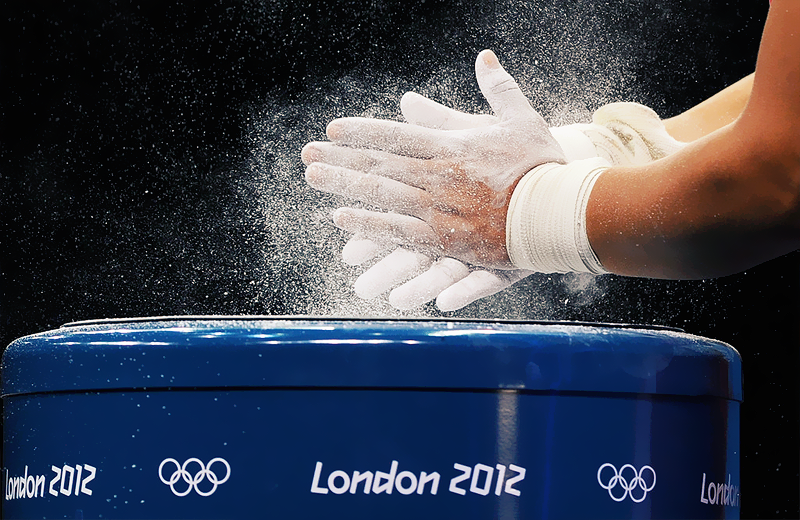
I’ll keep this post short because there isn’t much to be said. Powerlifters, gymnists, rockclimbers all use chalk. It is clearly effective.

The goal of lifting is not to work your grip strength, grip strength is useless in swimming. Missing a rep on pullups because of lost grip is only going to hurt you, and all the energy wasted on grip can be used better somewhere else.

Go to amazon, and buy yourself a bag of chalk. They cost 5-10$.

chalk

P.S. if you’re stingy like me, and think you can save money by using classroom chalk, don’t waste your time. I’ve already tried it, and it doesn’t work :p

Tracking you lifts

Many fitness trainers say the one golden rule to success in the weight room is to track your lifts.

It is quite obvious that it is important to track your progress in the weight-room if you are trying to progress.

Here are three reasons why:

  • 1) By tracking your progress, you are more likely to be consistent.

If you track your lifts, you are more likely to stick to a plan.

  • 2) You are more likely going to try harder

If you’re about to hit a set of dips and you see in your log that last week you did 7 reps on that particular weight, you are going to try extra hard to make sure you get in 8 this time.

  • 3) More data is always better!

You will learn what works best for you. Furthermore, if you plateau in an exercise it will be evident in the tracking log since you can look at the progress (or lack of progress) in the log. When you plateau you know it is probably time to try something new.

Conclusion: I recommend buying a little notebook and writing down all your workouts.

traklifts

Warm down ASAP

I see many swimmers don’t warm down right away. After they swim, they are either prancing around celebrating their best time, sulking in a chair because of a crappy swim, or talking to the coach about their swim.  All three of these things can be done AFTER warm-down. Don’t let the lactic acid just linger in your muscles. A long wait between competition and recovery gives the body more time to tighten, making it harder to flush out the lactate acid built up in muscles.

Go straight to warm-down.

First rule of Goal setting


Any team I have been on always has a time in the beginning of the year where the coach asks us to write down our goals for what we want to go by end of the season. We then go around one by one announcing our goals to the rest of the team.


There have been plenty of studies( Lewin(1926) Mahler(1933) Gollwitzer(1982)) that show that you are more likely to achieve your goals if you don’t announce them. The reason being you get instant gratification when announcing your goals even if you haven’t achieved them. This gratification is unjustified. Watch the TED talk below


Conclusion: Actions speak louder than words. Set your goals, keep them to yourself, work hard, and achieve them.

goalsetting1

Should I swim a workout with an empty stomach? (Fasted Endurance Training)

It is pretty common to see swimmers train with drag suits on. The idea is that training in a performance-dehancing condition creates a more potent training stimulus since your body must overcompensate to adapt to the hard conditions.

The question then is, if training with an empty stomach (ie. a performance-dehancing condition with limited muscle glycogen) could lead to superior training results.

I found one study that seem to have some interesting results.

The study’s aim was to see if  fasted state endurance training would yield greater improvements in fuel utilization and boost muscle glycogen storage efficiency.  The secondary aim was to see if the effects differed between genders, since men and women favor slightly different fuels during exercise. Men tend to utilize more glucose, while women tend to burn more fat.

The experiment

This study lasted four weeks and had all subjects cycling 25 minutes at 65% VO2Max five mornings the first week. The duration was then increased by 25 minutes per week, so that subjects were cycling 100 minutes in the final week.

The cycling was either done in the fasted state or one hour after a cereal-based breakfast (1.5 g carbs/kg). In weeks three and four the fed group also received 30 g of maltodextrin during training. The fasted group received the breakfast, and the maltodextrin, after training.

Week 1, fasted: 25 min cycling followed by breakfast.
Week 1, fed: breakfast followed by 25 min cycling.

Week 2, fasted: 50 min cycling followed by breakfast.
Week 2, fed: breakfast followed by 50 min cycling.

Week 3, fasted: 75 min cycling followed by breakfast.
Week 3, fed: breakfast followed by 75 min cycling.

Week 4, fasted: 100 min cycling followed by breakfast and maltodextrin.
Week 4, fed: breakfast followed by 100 min cycling and maltodextrin.

With regards to the diet maintained outside the laboratory, weighed food records were collected to ensure that potential differences could not be explained by differences in diet. This was done pre-training and in the final week. The findings showed that calorie intake increased in both groups, with an increase coming mainly from carbs and protein. But no difference in total calorie intake or macronutrient intake existed between groups


Results

VO2 max: Remember VO2 max is a measure of the maximum volume of oxygen that an athlete can use

Fasted: +9.7% increase
Fed: +2.5% increase

The fasted group increased their VO2Max significantly more than the fed group.

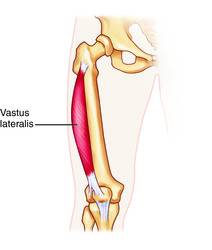
Muscle glycogen content:  shows how much glucose is stored in the muscle. The sample was taken from vastus lateralis, a portion of the quads, since this was the main muscle exercised during the cycling sessions.

Fasted: +54.7% increase
Fed: +2.9% increase


Summary:

Straight from the paper…

“The main findings of the present study were that: training in an overnight-fasted state enhances storage of muscle glycogen compared to training in the fed state; skeletal muscle of men and women respond differently in terms of oxidative activity to training in the fed and overnight-fasted state; and peak VO2 and peak power improved more when training in the fasted state compared to the fed state.”


My thoughts:

There seem to be some clear benefits of doing a workout in a fasted state. However I encourage you to do your own research and try training fasted a few time to see how it works for you. It will most likely be very hard the first few times, but your body should adjust over time. If you do decide to train fasted, I highly recommend taking 10 grams of BCAAs prior to the workout to prevent muscle catabolism.


Why I study powerlifters

Person A weighs 150lbs and can bench 275lbs. Person B weighs 200lbs and can bench 300lbs.

As a swimmer which person would you rather be?

Clearly person A as he is lifting 1.83 times his bodyweight compared to the 1.5 of person B.

Person A has a higher relative strength than person B.

An important component of swimming is relative strength.  Ideally you want to maximize propulsion by increasing strength whilst minimizing your drag. Although drag is proportional to surface area and not weight, weight is correlated to drag and is much easier to measure. For this reason, relative strength is a very important component of swimming.

I study powerlifters because they have an extremely high relative strength. Why? Because it is their sole purpose. While a swimmer’s performance is measured by how long it takes them to complete x many laps, a powerlifter’s performance is based on how much they can lift compared to other competitors in their weight class.

The world record for bench in the 150lb class is 498lbs! That’s over three times his bodyweight!

You will see in further posts that a lot of my inspiration comes from powerlifting.