When practicing for the one arm chin-up (OAC) , I purchased a pair of gymnastic rings to prevent elbow strain from practicing on the bar. However, I tried various other exercises on the rings such as the dip. Although I can do dips on the bar with 120lbs attached to me, on the rings I was barely able to do them with just my bodyweight. Furthermore, I was shaking immensely when doing them, meaning that a lot of my energy was going into stabilization. This was a humbling experience but also a very important one. It taught me that my stabilizers were weak since I was only practicing dips on the bars. Since swimming is done in an unstable environment (unlike land sports where the athlete is grounded), I believe stabilization work is vital. It is important to practice many exercises such as the rows, front-lever pull downs and dips on the rings.
“Everything new is a well-forgotten old” – Russian proverb
Although the TRX is good and is used by many swimming programs to work the stabilizers I believe the TRX is just a big marketing scam. It is just a copy of the original gymnastic rings. Furthermore, the TRX costs over $200 compared to the rings that cost less then $20 (because people are silly enough to pay $200 for nylon straps). Lastly, the TRX doesn’t allow for movements such as muscle-ups, dips and rows. You can do pretty much all the TRX exercises using the rings, but you can’t do all the rings exercises on the TRX.
Conclusion: Invest $20 on a pair of gymnastic rings to work on your reactive stability.
After college, I started to incorporate weighted dips into my strength training routine. I found it to be an amazing exercise. It works the chest, shoulder, and triceps as well as shoulder flexibility. Furthermore, since it is a closed-chain movement (ie. hands are fixed in space and do not move), it is much safer. I have never injured myself doing this exercise. I can’t say the same for the bench press.
After discovering the benefits of dips, I was a little agitated that they were not part of the weight training program I was on in college. This made me start to question the other exercises that were performed in the college strength training routine. We were performing various isolation exercises such as skull crushers and triceps extensions. Should we really be doing the same isolation work that body-builders do? Furthermore, isolation movements (especially triceps ones) are extremely unnatural. In comparison, think about how often we use closed-chain compound movements.
Every time you get in and out of your seat, you are performing a squat, and every time you drop your keys and need to pick it up, you are performing a dead-lift. When you jump out of the pool, you are doing a pull up followed by a dip. Have you ever had to do a movement similar to skull-crushers in everyday life? Most likely not. Unnatural movements, more often than not, can lead to injuries.
I am drifting off topic, so let me get to my main argument. My theory is that pull-ups and dips should be the main focus for swimmers in the strength training. The two exercises work the first and second half of the stroke respectively. Luckily enough, I was able to find a study that was able to test my hypothesis.
Study:
Scientists at Ball State University in the United States divided 10 highly trained male collegiate swimmers into two groups. Members of both groups maintained a daily swimming volume of about 5600 metres, with most of the work consisting of intervals designed to produce an exercise intensity of greater than 85% V02max (over 90 per cent of maximal heart rate).
Strength training was conducted twice a week for six weeks, but the two groups used different resistance-training techniques. One group utilized a weight-assisted dip and pull-up training device. This first group completed three sets of dips and pull-ups per workout, with as many repetitions as it took to reach complete fatigue during each set.
The second group carried out traditional weight-training routines, with lat pull-downs, elbow extensions, elbow flexions, bent-arm flys, quadriceps extensions, and hamstring flexions serving as mainstays of the program. All swimmers performed three sets of each exercise with eight to 12 reps per set, using increasing resistance over time.
In the study, the six weeks of swimming and strength training were followed by six weeks of swimming-only workouts.
Results:
Over the 12-week period, there were no differences between the two groups in lean body mass or per cent body fat. However, the weight-assisted dip and pull-up swimmers fared slightly better, compared to the traditional strength trainers. For one thing, they improved their 22.9 meter front crawl sprint time by .3 seconds, from 11.2 to 10.9 seconds, while the traditional people failed to improve.
Their conclusion:
“Weight-assisted dips and pull-ups may be more like typical swimming motions, compared to routine strength-training routines, and therefore might be better at improving actual swim-stroke power.”
My Conclusion:
The results of this study seem to be in line with my theory that pull-ups and dips should be the main focus in the weight room for swimmers. However this is just one study and it is important to keep an open-mind.
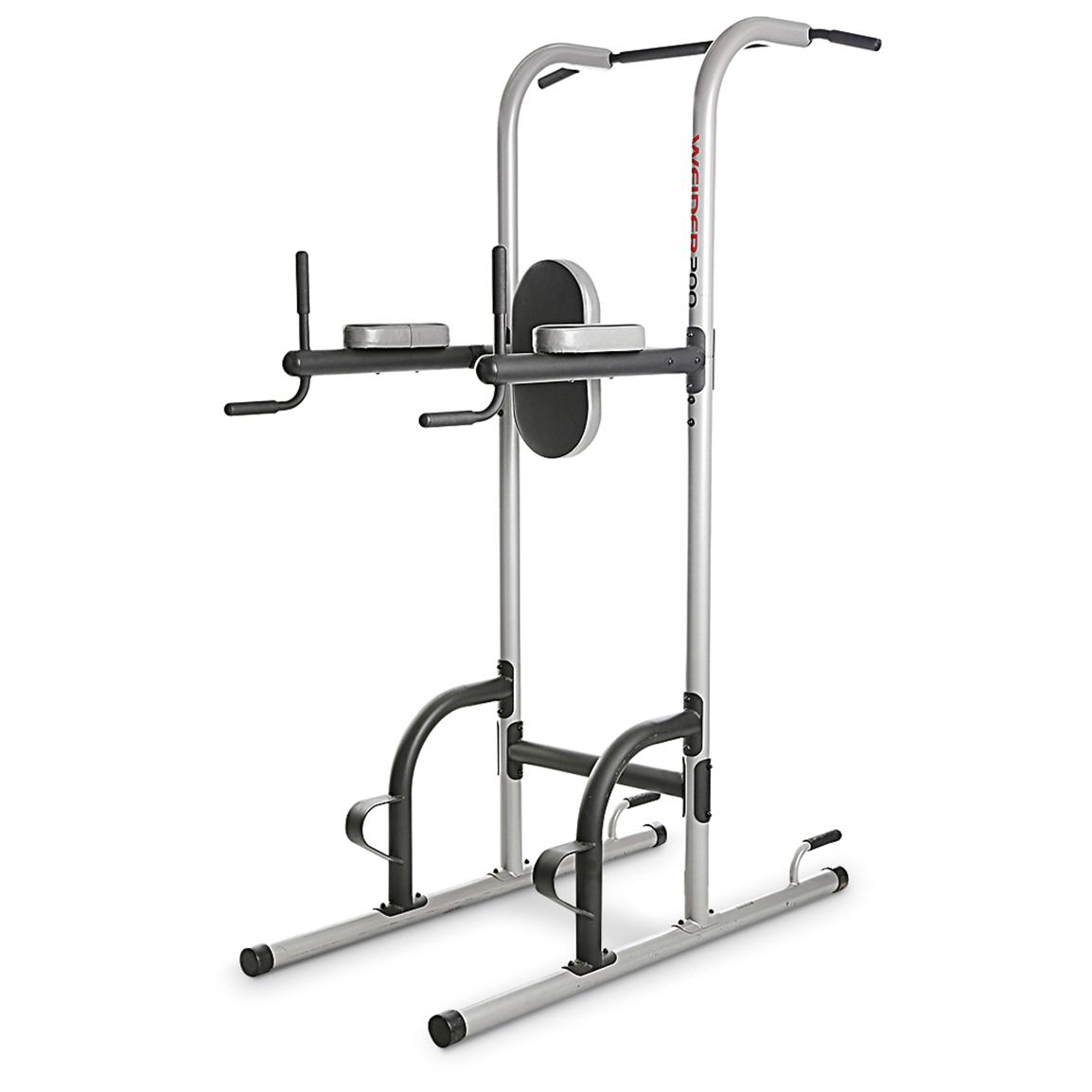
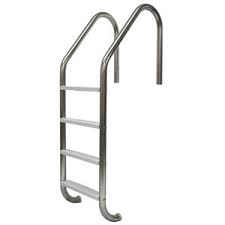
The great thing about pull-ups and dips are that they do not require expensive equipment. You can purchase a power tower (shown below) for just under $100, and have it on the pool deck. You can also buy an over-the-door pull-up bar for $20 and buy a pair of gymnastic rings for an additional $20 to perform dips. Dips can also be performed on the pool ladder.
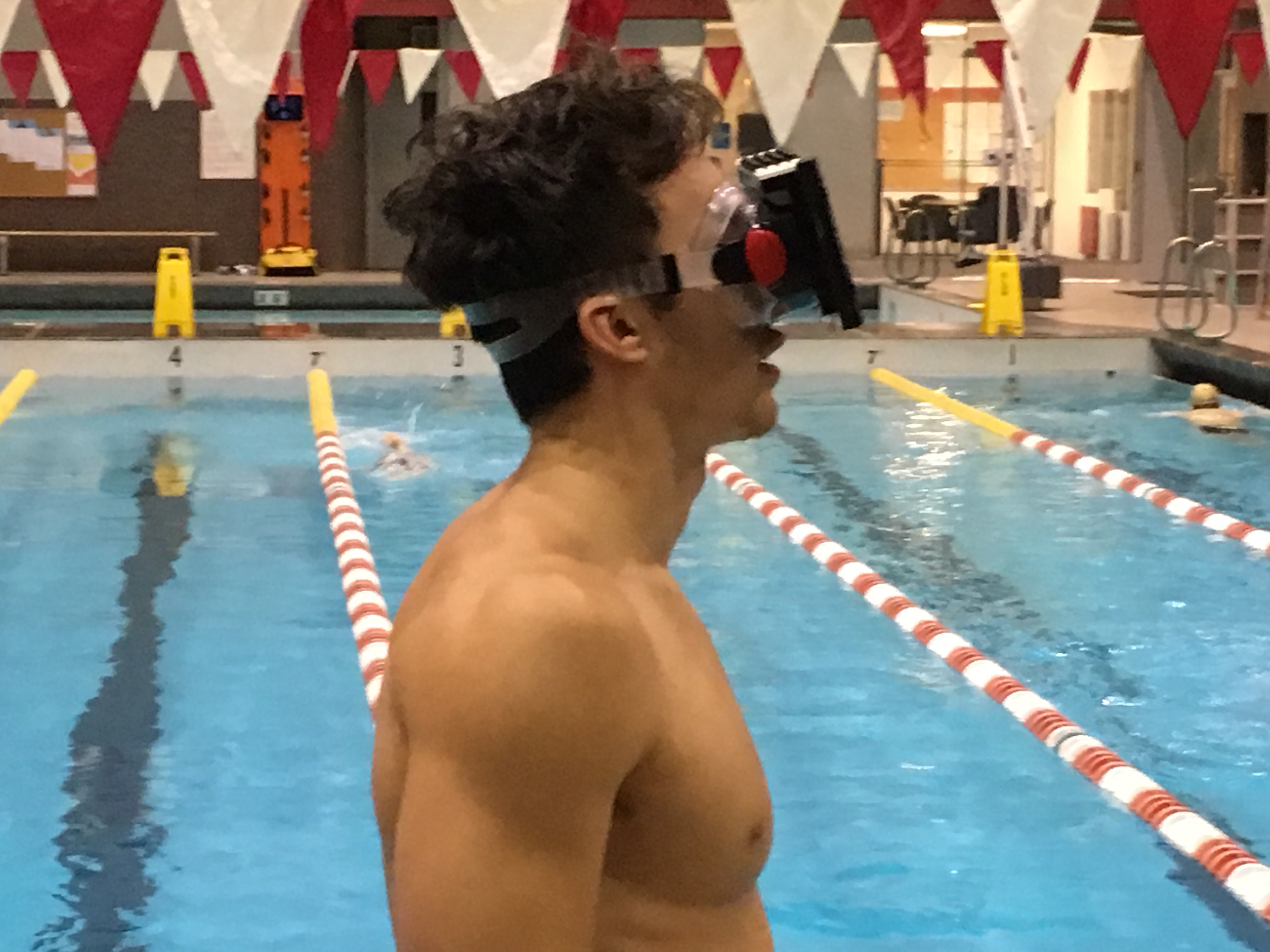
This semester I’ve been lucky enough to be an RA at the MIT Media Lab Fluid Interface group. After finishing the semester I decided to take a few days to build a pair of smart goggles. I was able to create a pair that could tell you the current time, your splits, your stroke rate and the amount of laps you’ve done all in real-time. Furthermore, the total materials I used cost less than 30$ (excluding a smartphone)!
Below is the display that the swimmer sees. I used the accelerator of the phone to detect each stroke to calculate the stroke rate and each push-off to calculate the laps.
What’s next? I would love to tell you but I shouldn’t for reasons explained in my previous post!
Want to learn how to maintain strength, endurance mobility and prevent weight gain during a vacation? Grab a free e-book where I offer the short bodyweight workouts and nutrition plan that I use that still allows do this without sacrificing your relaxing vacation.
Ten years ago, Kosuke Kitajima was by far the best at the breaststroke pull-outs. At 5’10″ that is a pretty impressive feat. What was it that made him better than everyone else? No, not his illegal dolphin kick. Even after 2005 when FINA legalized the dolphin kicks in the pullouts, he was still ahead of the rest as shown below. This was the 2008 Japanese Olympic Trials. You can see he makes over a half body lead just with the start.
In an interview he mentioned that he would shrug his shoulders during the pull-out. This lessened his drag profile and helped him go farther and faster. He no longer has that edge as all world class breaststrokers shrug their shoulders now.
It seems bizarre that people were doing something seemingly simple in a sub-optimal fashion. This inspired me to look at the regular streamline. Is it done optimally?
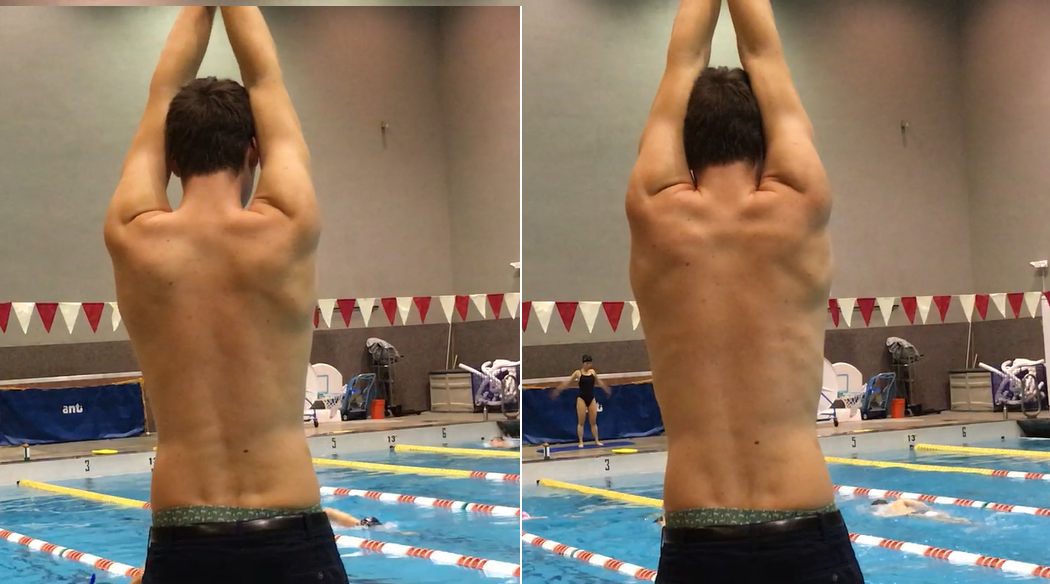
I asked a former teammate to get into the best streamline position he can, later I asked him to shrug his shoulders while in the streamline position. There is a pretty evident difference between the two.
Firstly, he was able to improve his drag profile by making his streamline longer and narrower.
Secondly, he was able to eliminate the space between neck and shoulders which decreases the surface area of skin to water contact, and thereby decreases friction resistance.
I also tried the two streamlines and although the difference is not as obvious my drag profile is improved with the narrowing of my streamline
.
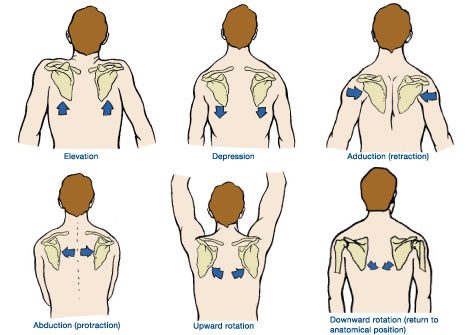
I encourage you to play with this idea as well and for those interested here are the various scapula movements and their names.
Lactic Acid is produced in muscle cells. During strenuous exercise the levels of lactic acid increase in the body causing the pH in the body to decrease. This leads to metabolic acidosis, which is what we feel as muscle fatigue.
Baking Soda or sodium bicarbonate is alkaline. It also acts as a buffer. A buffer resists pH change upon the addition of an acidic or basic components.
The idea is to use baking soda to act as a buffer to resist pH change due to lactic acid buildup. If this works, we can reduce metabolic acidosis/fatigue and theoretically increase performance.
Study
There have been plenty of studies done on this topic I will cover three studies done in varying sports.
Cycling:
Experiment: Twenty-three subjects participated in this study, which included eight females and fifteen males, aged at 21.4 ±2.3. Subjects completed six trials, three following the ingestion of sodium bicarbonate (300mg/kg bodyweight) and three following the ingestion of a placebo (8g of sodium chloride or salt). Each trial consisted of ten, ten-second sprints on a cycle ergometer with a fifty-second recovery between each sprint.
Results: The bicarbonate trial produced higher mean average power outputs in all ten of the ten-second sprints, with the difference in average power output being statistically significant in eight of these.
Weightlifting:
Experiment: The participants used 80% of their max weight on the squat . They did three sets of each exercise to failure using this weight, with three minutes of rest in between sets and five minutes in between exercises. In random order and on different days, each person either consumed baking soda or a placebo an hour before lifting.
Results: The average total reps over three sets without baking soda was 24.6, but with baking soda, the average was 31.3.
Swimming:
Experiment: Nine swimmers swam the 200 meter freestyle under three conditions: normal supplement-free conditions; 60 to 90 minutes after taking sodium bicarbonate capsules; and 60 to 90 minutes after taking calcium carbonate capsules, which served as a placebo.
Results: “On average, the swimmers shaved 1.5 seconds off of their performance time”.
Conclusion: There is no doubt that baking soda is effective. It was been known and used by athletes since the 1930s.
Recommended Dosage: 0.3 grams per kg of body mass or .15 grams per pound. Since it gets absorbed quite quickly take approximately 1 hour before training/competition.
Caution: Side effects of baking soda include “gastrointestinal woes like cramps, nausea and diarrhea”.
When I recently became serious about mobility training, I did some research and came across a unique stretching protocol that I later applied and found to be very effective. It is called PNF stretching, or proprioceptive neuromuscular facilitation stretching. It is a set of stretching techniques commonly used in clinical environments to enhance both active and passive range of motion in order to improve motor performance and aid rehabilitation. The technique is as follows:
Stretch until maximum range of motion (ROM) is reached
Contract (20-30% max effort) the stretched muscle for 5-10 seconds
Repeat 1) and 2) 3-6 times until ROM no longer increases
You will notice that after contraction , you will be able to will be able to go into a deeper stretch (when repeating step 1). The idea comes from the fact that when stretching regularly not all the muscle fibers in your muscles are being stretched. By contracting the muscle under tension, you activate more of the muscle fibers to become stretched, thereby increasing your ability to go into a deeper stretch.
Some important things to know:
Do not do this before swimming or any form of exercise. Static stretching should always be done afterwards.
It is normal to experience muscle soreness the next day.
Do not do this everyday. This form of stretching is very intense and should be treated like weightlifting. I personally get the best results using this protocol once every 3 days.
Yes, it is okay to stretch on the off days (but not in the PNF fashion).
This is a form of static stretching. Be sure to incorporate dynamic stretching in your mobility training as well.
This is a very intense and advanced form of stretching. BE VERY CAREFUL. Take your time, one stupid move and you can seriously injure yourself.
I will post some stretches that can be done for swimmers using this protocol in a few days.
Being both a dancer and swimmer for many years, I can say there is a great similarity between the two.
I practice a funk style dance called locking. Although there are many variations, there are only about 10-15 moves in the dance. Even though I have been practicing for over ten years, I have not achieved mastery in the dance.
You may think I’m a slow learner, but ask yourself this.
Swimming has five moves. Freestyle, backstroke, butterfly, breaststroke and the dolphin kick. How long have you been swimming and have you mastered all five yet?
On most swim teams it is quite common to go hit the weights as a team. Unfortunately this is one of the worst things that can be done. Since the whole team usually has the same lift plan (ie. does the same exercise) swimmers try to rotate through the lifting plan. For simplicity lets assume there are 9 swimmers and 3 exercises for the workout: Dips, lateral raises(LR) and tricep extension(TE). So three people would start on dips , three would start on LR and three would start on TE. This is a bigmistake. In this scenario, dips should always be performed first. It doesn’t matter to me if you eat dessert before dinner, but do not do accessory exercises before the big compound ones! Big compound exercises such as dips, chin-ups, standing press, and squats are the most important exercises for getting stronger. In terms of the Pareto Principle, these are the 20% that give 80% of the results! I honestly want to say they are going to give you 90% of the results. It is important to start your workouts with these so you can hit some big numbers and ideally hit a PR.
So here are two options:
-lift at different times
-be patient and wait your turn to do the compound exercise first.
Furthermore I think it is important to keep the same order in your workouts so you can track your progress better. Even with the secondary (such as rows) and accessory exercises try to keep them the same order if possible.
Watching David Blaine’s TED talk “How I Held my Breath for 17 minutes”, I was inspired to look into this. David Blaine got the world record in the static apnea with supplemental pure oxygen. He was the allowed to pre-breathe 100% oxygen (as opposed to regular air that is 21% oxygen) for up to 30 minutes prior to breathe-holding. He no longer has the record but for the sake of this post here are the current static apnea records for both with and without pure oxygen supplementation.
Humans can hold their breath almost twice as long with pure oxygen! So I did my research…and here’s what I found.
Q1: Do other sports use pure oxygen?
A1: Yes, if you watch NFL you will see football players breathing pure oxygen on the sidelines between plays.
Q2: Is it easy to obtain pure oxygen?
You can obtain canisters on amazon that are 95% oxygen for about 10$.
Q3: Is it effective?
After going through a few papers it seems they all agree that there is no benefit in breathing pure oxygen.
Q4: Why do they do it?
Not entirely sure. Possibly a placebo effect.
It seems that for athletic performance, ridding the body of CO2 is more important than increasing the body with O2. Furthermore the hemoglobin in your body can only hold so much oxygen at a time. The only possible scenario where pure oxygen may help, is if you have a swim meet in high altitude, but I don’t think most people need to worry about this.
Back in college, the weightlifting program incorporated rep schemes such 10,8,6 or 12,10,8. Also known as the strandard pyramid scheme. The goal is to increase the weight on each set whilst decreasing the the repetitions. Such as the example below.
Incline Dumbell press:
Set 1: 10 reps – 65 lbs
Set 2: 8 reps – 70 lbs
Set 3: 6 reps – 75lbs.
However I was rarely able to do this, instead this is what I usually got.
Set 1: 10 reps – 65 lbs
Set 2: 6 reps – 70lbs
Set 3: 2 reps 75lbs or 5 reps 70lbs.
Due to fatigue I usually cannot complete the second set. After failing the second set, I either attempt to stick to the weight scheme on the third set and fail miserably or I try to stick to the rep scheme as close as possible by not increasing the weight. I believe that unless you are a total beginner with no muscle mass to feel the fatigue or you are just not working at a high intensity on the previous sets it is almost impossible to complete this.
After a while of be unable to perform the rep-weight scheme of the standard pyramid scheme, I started to train the way I thought was natural, which was the heaviest weight first.
After college, I learned that it’s actually called reverse pyramid training (ie. RPT). The example is below
Set 1: 6 reps – 75 lbs
Set 2: 8 reps – 70 lbs
Set 3: 10 reps – 65 lbs.
This also makes the lifting a lot more fun. Just like racing on taper is awesome, being able to hit the biggest weight fresh is fun since you can perform much better. I’m always excited to hit the gym and see if I can hit PRs.
A swimmer’s main goal in the gym in-season should not be to gain muscle mass but gain strength. I think RPT is great for this since you will be lifting heavier weights. YOU WILL BE SURPRISED HOW MUCH HEAVIER YOU CAN LIFT on your max set when you hit them first. Since you will be lifting much more weight it is going to train your central nervous system much more. Improved CNS is the key to getting stronger without adding size. RPT is also better for a low volume weightlifting routine which is what I recommend in-season.
 by
by