On average swimmers tend to have a higher body fat percentage than land athletes. Swimming is an extremely forgiving sport when it comes to body fat. However between having the 3% body fat that is necessary for organ function and being 500lbs, there must be an optimal amount.
Study:
In a study done by the University of Miami, researchers artificially increased the bodyfat of 10 male and female swimmers by 2% or approximately 3.5 pounds. Fat was added by adding latex pads under a spandex triathlon suit in the swimmers’ abdominal, hip, thigh, chest, back, and buttock areas. The artificial fat was adjusted to ensure that it would have the same density as actual body fat. Each athlete swam a 50-yard freestyle race as fast as possible, with and without the pads.
Results:
“While the latex pads did improve flotation, they also slowed the swimmers down considerably. The athletes could rip through their 50-yard sprints in about 26.6 seconds without the added ‘fat’ but required around 27.4 seconds with the additional fat on board. Thus, each additional pound of fat slowed 50-yard swim times by approximately .2 seconds.”
My thoughts:
Now we should take this study with a grain of salt. Clearly it is far from perfect. It would be a lot more believable if the athletes actually gained 3.5 lbs of real fat for this experiment… Furthermore they only compared the performance in a 50 freestyle.. This is what I want to focus on..
One of the possible advantages of body fat is buoyancy since fat is less dense than lean body mass and the water. This can be very helpful in longer distances where the swimmers conserves energy by kicking less intensely (such as in a two beat kick). However in a shorter race buoyancy the swimmer is kicking much harder and buoyancy from fat is not going to be as necessary to keep the body parallel to the surface.
Secondly I believe that the main disadvantage of body fat in addition to the increased drag (via surface area) is from the energy dissipation due to vibrations. For those readers who haven’t come upon this concept before , this is the reason why competition suits are meant to be tight. Ian Thorpe used to have to cut his swim suits off with scissors. In shorter races where you are kicking very hard there will be a lot more energy dissipation if you have a high body fat percentage.
Furthermore this could be why the people who improved the most with the tech-suits back in ’08-’09 were the larger athletes.
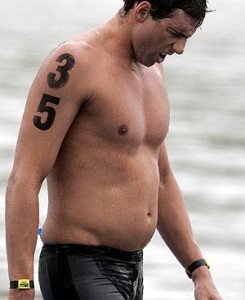
Conclusion: I believe that its impossible to say there is an optimal amount that is general to every swimmer. Since everyone swims differently, has different limb proportions and adds fat differently to their body the number will change on an individual basis. I do believe however that being lean is more important for sprinters than distance swimmers. I conclude with a picture of former 1500m World record holder Grant Hackett who is currently doing a great job at making a comeback for the upcoming Olympics.
 by
by